
philosophy of tarot · card essay · temperance (XIV)
Temperance and the Golden Mean: Aristotle's Most Misunderstood Idea, Poured Between Two Cups
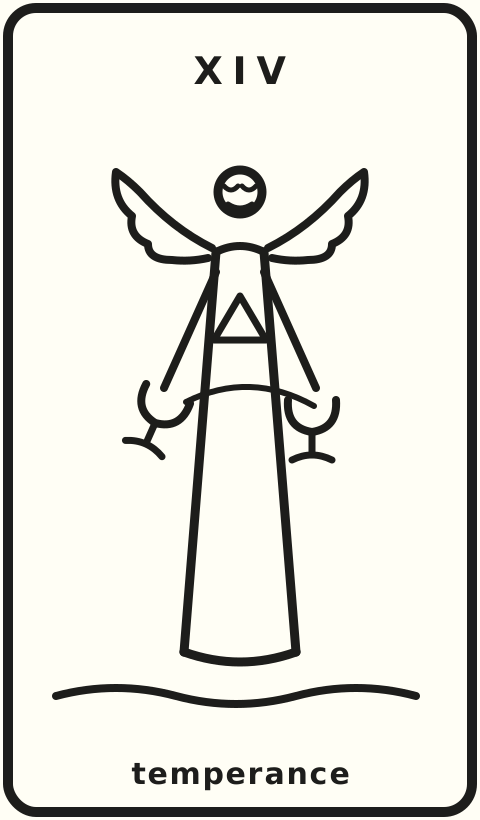
The angel of Temperance performs a small physical impossibility: water flowing between two cups at an angle that gravity should forbid. Waite’s Pictorial Key (1911) describes the figure “pouring the essences of life from chalice to chalice.” Nothing spills. Nothing is finished either — the pour is perpetual. The card freezes an action that only exists as an ongoing adjustment.
That is a better illustration of Aristotle’s doctrine of the mean than most philosophy textbooks manage.
What the mean actually is
In Nicomachean Ethics II.6 (1106b, Ross’s translation), Aristotle defines moral virtue as “a kind of mean, since it aims at what is intermediate.” The famous examples: courage is the mean between cowardice and recklessness; generosity between stinginess and profligacy; good temper between spinelessness and irascibility.
The doctrine is routinely flattened into “moderation in all things” — beige advice for beige lives. Aristotle says nearly the opposite. Three corrections from the text:
First, the mean is relative to us, not to the arithmetic. “The intermediate relatively to us is that which is neither too much nor too little — and this is not one, nor the same for all” (1106a). Six pounds of food may be a mean for Milo the wrestler and excess for a beginner, Aristotle notes. The right amount of confrontation, ambition, or grief is indexed to the person and the situation. Temperance’s pour is calibrated live, cup to cup — not measured once and locked.
Second, hitting the mean is hard and rare. “It is possible to fail in many ways… while to succeed is possible only in one way; for which reason one is easy and the other difficult” (1106b). Aristotle compares it to hitting the centre of a target. The card’s traditional keyword “patience” follows: precision takes time that excess never needs.
Third, some acts have no mean. Aristotle is blunt: envy, spite, adultery — “it is not possible, then, ever to be right with regard to them; one must always be wrong” (1107a). Temperance is not the card of compromise with everything. Some cups should be put down, not blended.
The angel’s feet
In the classical image one foot rests on land, one in water — matter and spirit, but also Aristotle’s two conditions for virtue: it must be practiced (land: habit, the repeated act — “we become just by doing just acts,” 1103a) and felt appropriately (water: virtue concerns “passions and actions” both). A person who does the right thing while seething is, for Aristotle, not yet virtuous but merely continent. The mean runs through the emotions, not around them.
The Eastern check: Daodejing 9 and the middle way
Laozi arrives at the pour from the other bank: “It is better to leave a vessel unfilled than to attempt to carry it when it is full… When the work is done, and one’s name is becoming distinguished, to withdraw into obscurity is the way of Heaven” (Daodejing ch. 9, Legge). Where Aristotle calibrates the target, Laozi warns about the archer’s appetite: the moment of “enough” arrives earlier than desire reports.
The Buddhist middle way — the Buddha’s first sermon steers between indulgence and mortification — makes the same claim at the scale of an entire life. Temperance, read across all three traditions, is not the virtue of the lukewarm. It is the discipline of the exact.
Reading it in practice
Upright, Temperance asks where the pour is in your life — which two things you are actually blending (work and rest, honesty and kindness, saving and living) — and whether the proportion was chosen or merely inherited. Reversed, it marks the two spills: excess that calls itself passion, or a rigidity that calls itself balance while the water goes stale.
Our deck’s question for the card: in which part of your life would “enough” actually be the more ambitious goal?
Sources. Aristotle, Nicomachean Ethics II.1–II.9 (1103a–1109b), V; trans. W.D. Ross (public domain). A.E. Waite, The Pictorial Key to the Tarot (1911, public domain). Daodejing ch. 9, trans. James Legge (1891, public domain). On the card’s iconographic history: Helen Farley, A Cultural History of Tarot (2009).
Try the reading tool: draw the five-card crossroads spread and see where Temperance lands — every interpretation cited to its source.