philosophy of tarot · card essay · the hermit (IX)
The Hermit and Plato's Cave: Why the Lamp Matters More Than the Mountain
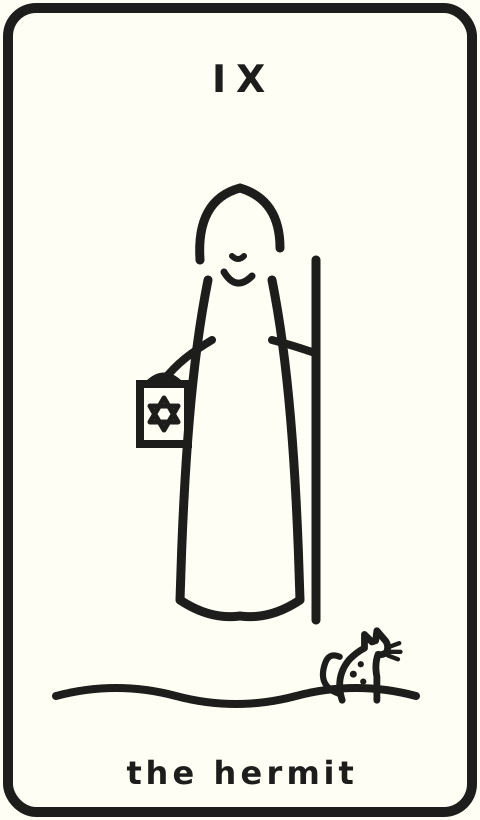
There is a detail in the classical image of the Hermit that most readings pass over. The figure stands on a mountain peak — the journey apparently complete — and yet still holds the lantern up. A.E. Waite, whose 1911 Pictorial Key to the Tarot fixed the card’s modern form, wrote that the Hermit’s beacon is not merely for himself: “his beacon intimates that where I am, you also may be.” The light is carried for someone who has not arrived yet.
Twenty-three centuries earlier, Plato built the same image out of shadow and firelight.
The cave, briefly and precisely
In Book VII of the Republic (514a–520a, Jowett’s translation), Socrates asks Glaucon to imagine prisoners chained since childhood in an underground cave, able to see only the wall in front of them. Behind them burns a fire; between fire and prisoners, objects are carried whose shadows fall on the wall. The prisoners take the shadows for the whole of reality — as anyone would, having never seen anything else.
One prisoner is freed. The ascent is not triumphant; it is painful. The fire blinds him, the climb is steep, and when he finally stands in daylight, “he will suffer sharp pains; the glare will distress him.” Only gradually can he look at real things, then at the stars, and at last at the sun itself.
Then comes the passage the Hermit card lives in. The freed prisoner goes back down. Plato is explicit that he must: the philosopher who has seen the sun is obliged to return to the cave and “endure the ridicule” of those who never left — who will find his daylight-adjusted eyes clumsy in the dark, and will conclude that the journey up ruined his sight (516e–517a).
The Hermit is the return, not the retreat
Read the card against this text and its geometry changes. The mountain is the outside of the cave; the lantern is the carried memory of the sun; and the Hermit’s characteristic posture — standing still, light held out — is the philosopher paused at the cave mouth, on the way back in.
This corrects the two standard misreadings of the card. The first treats the Hermit as mere solitude: introversion, winter, a phone on silent. The second treats him as escape — the one who left and is never coming back. Plato blocks both. Solitude, in the Republic’s account, is an instrument, not a destination; the ascent is for the sake of the descent. Socrates says the founders of the just city must not permit the enlightened “to remain in the upper world” (519d). The examined life — the phrase comes from the Apology, 38a, “the unexamined life is not worth living” — is examined in public, at the market, annoyingly, among others.
When the Hermit appears in a reading, then, the Socratic question is not “should I withdraw?” It is: what is the withdrawal for, and who gets the light afterward?
The Eastern check: Daodejing 47
Comparative honesty requires noticing where the traditions pull apart. The Daoist counterpart to the Hermit is chapter 47 of the Daodejing (Legge’s translation): “Without going outside his door, one understands all that takes place under the sky… The sage acquires knowledge without travelling.” Where Plato demands an arduous ascent and a dutiful return, Laozi suggests the whole journey is unnecessary — the mountain was in the room the entire time.
These are genuinely different epistemologies, and the card can hold both. Plato’s Hermit earns wisdom by leaving; Laozi’s sage finds it by staying so completely that leaving becomes redundant. What they agree on — and what the card insists on — is that the crowd’s noise and the truth’s signal are rarely the same frequency, and that some distance, physical or interior, is the price of telling them apart.
Reading it in practice
Upright, in the position of counsel, the Hermit prescribes deliberate distance with a deadline and a deliverable: go up the mountain, but book the return trip before you leave. Reversed, it usually marks one of the two failure modes Plato foresaw — the refusal to climb (staying chained because the shadows are at least familiar), or the refusal to descend (solitude curdled into superiority, the lamp kept as private property).
The card’s question, in our deck’s phrasing: what question are you avoiding by staying busy among other people?
And its harder twin, for the long-term Hermit: whom is your lamp actually for?
Sources. Plato, Republic VII 514a–520a and Apology 38a, trans. B. Jowett (public domain; Project Gutenberg). A.E. Waite, The Pictorial Key to the Tarot (1911, public domain). Daodejing ch. 47, trans. James Legge (1891, public domain). On the card’s history: Michael Dummett, The Game of Tarot (1980).
Try the reading tool: draw a single card in the Socratic mode, or enter a spread you drew at home — every interpretation cited to its source.